
July 2026 – First listening Evaluations and Design Conclusions
Contents
- Optimizing the Dipole Cabinet
- Crossover Design
- Audio Technology and Mundorf Drivers
- 4-way versus 3-way Dipole Loudspeaker
Optimizing the Dipole Cabinet
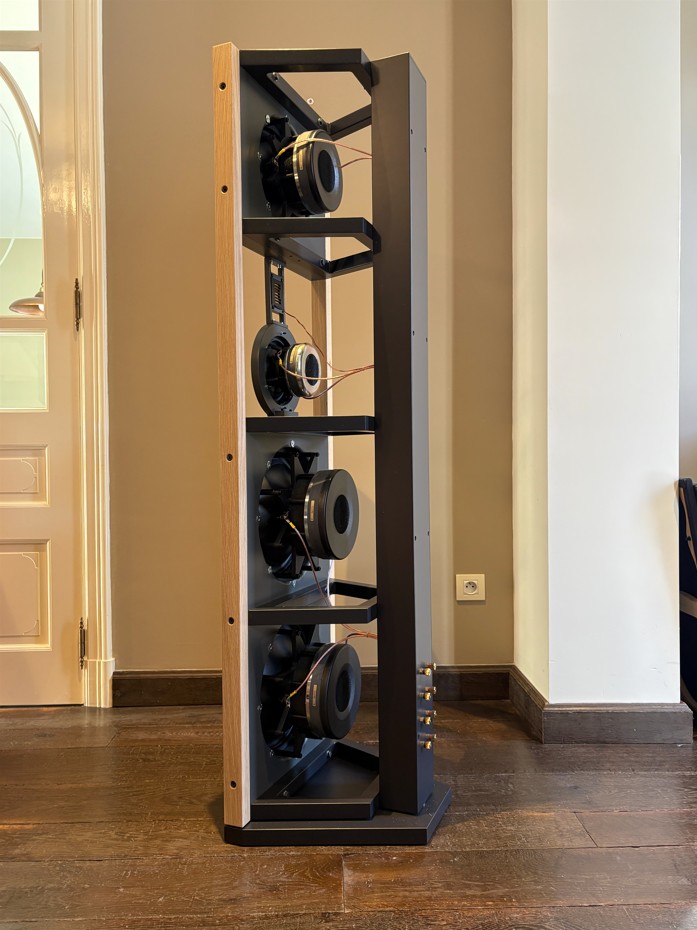
The vertical support at the rear of the cabinet is an integral part of the enclosure construction and also serves as a cable channel. In the first cabinet version, this support consisted of a closed structure measuring 12 cm wide, 8 cm deep and 151 cm high, positioned 22 cm behind the front baffle.
Listening tests and acoustic measurements revealed that this construction produced strong rear reflections from the midrange and tweeter drivers. These early reflections arrived only 1.6 ms after the direct sound and had a relatively high amplitude. As a result, the midrange and tweeter output was slightly reinforced, introducing unwanted coloration to the sound. In addition, accurate acoustic measurements became virtually impossible, as the reflections limited the reflection-free FFT window to only 1.6 ms.
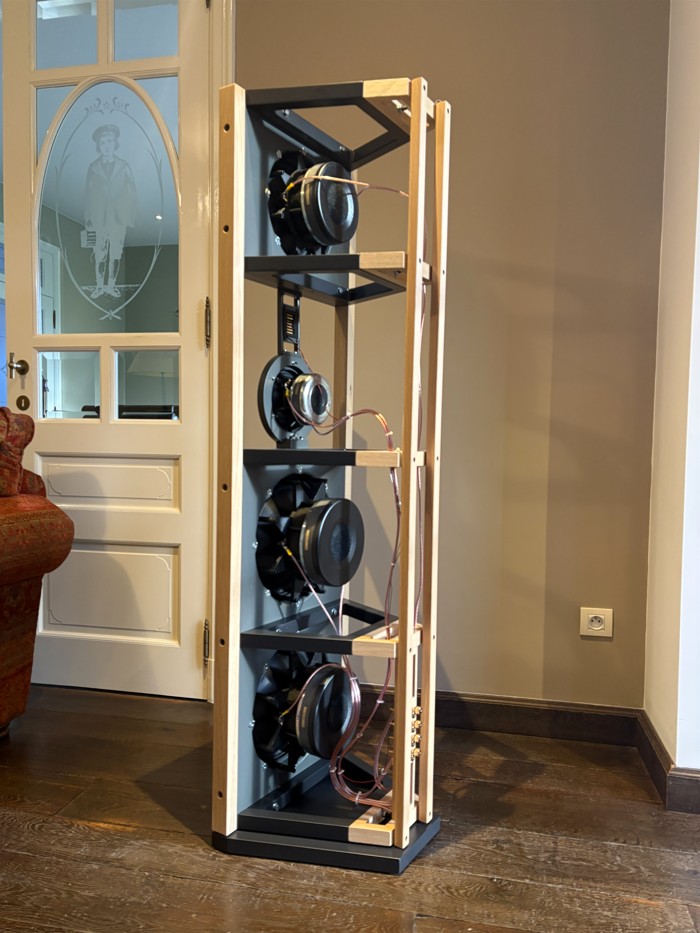
It became clear that this construction was not suitable for a high-performance dipole loudspeaker. The closed rear support was therefore completely redesigned into an open, highly transparent framework using narrow wooden slats. This greatly reduced rear reflections and allowed the loudspeaker to perform as originally intended.
The photographs below show both cabinet versions: the original design with the closed rear support and the final version featuring the open, acoustically transparent construction.
Crossover Design
During development, several crossover topologies and crossover frequencies were evaluated. After extensive listening tests, the fourth-order Linkwitz-Riley (LR4) crossover consistently delivered the best overall performance.
The LR4 crossover provides an exceptionally natural tonal balance, an open and spacious soundstage, and the most precise imaging of all crossover alignments tested. Instruments and voices are placed with remarkable accuracy, creating a highly convincing three-dimensional presentation.
For the VCL DI-3212-P 3-way system, the final crossover frequencies were selected at 250 Hz and 2500 Hz.
VCL DI-3212-P – VCLLabs
For the VCL DI-4212-P 4-way system, the preferred configuration uses crossover frequencies of 120 Hz, 550 Hz, and 2500 Hz.
VCL DI-4212-P – VCLLabs
An additional 3.5-way configuration was also developed for the 4-way concept using LR4 crossovers at 250 Hz and 2500 Hz. In this configuration, the midwoofer and midrange operate together over the 250 Hz to 2500 Hz frequency range in a gradual 1.5-way arrangement, resulting in an exceptionally coherent midrange presentation.
Back to top of page
Audio Technology and Mundorf Drivers
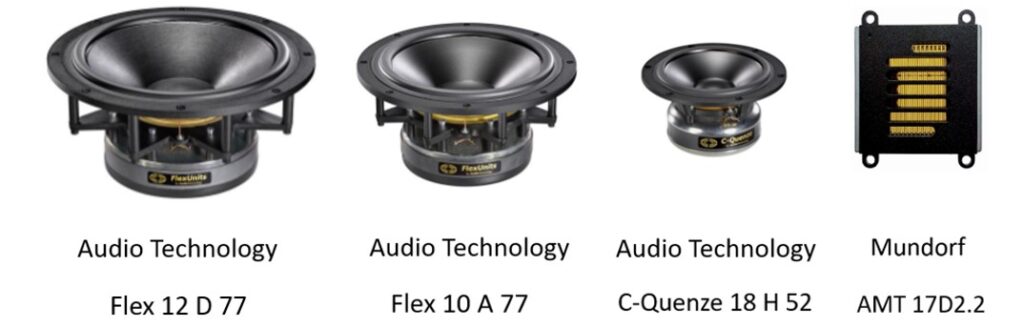
For the woofers, midwoofer and midrange, we selected Audio Technology drivers. To optimize the drivers specifically for dipole operation, Flexunits were chosen for both the woofers and the midwoofer, allowing the driver parameters to be tailored to the application.
These Audio Technology drivers perform exceptionally well in our dipole loudspeakers. Their presentation is remarkably natural, relaxed and effortless, while offering outstanding detail retrieval, excellent dynamics and superb transparency. Throughout our evaluations, they have consistently impressed us with their musicality and realism. We can highly recommend these drivers for anyone designing a high-end loudspeaker system.
For the high frequencies we selected the Mundorf AMT tweeter. It is one of the very few tweeters currently available that exhibits truly excellent dipole behaviour. The tweeter delivers a refined and highly detailed presentation without any trace of harshness or aggressiveness. It also contributes significantly to the wide, deep and highly stable soundstage that characterizes these dipole loudspeakers. A future evaluation will compare the Mundorf AMT dipole tweeter with a back-to-back configuration using two dome tweeters, allowing us to further investigate the sonic differences between both concepts.
Back to top of page
4-way versus 3-way Dipole Loudspeaker
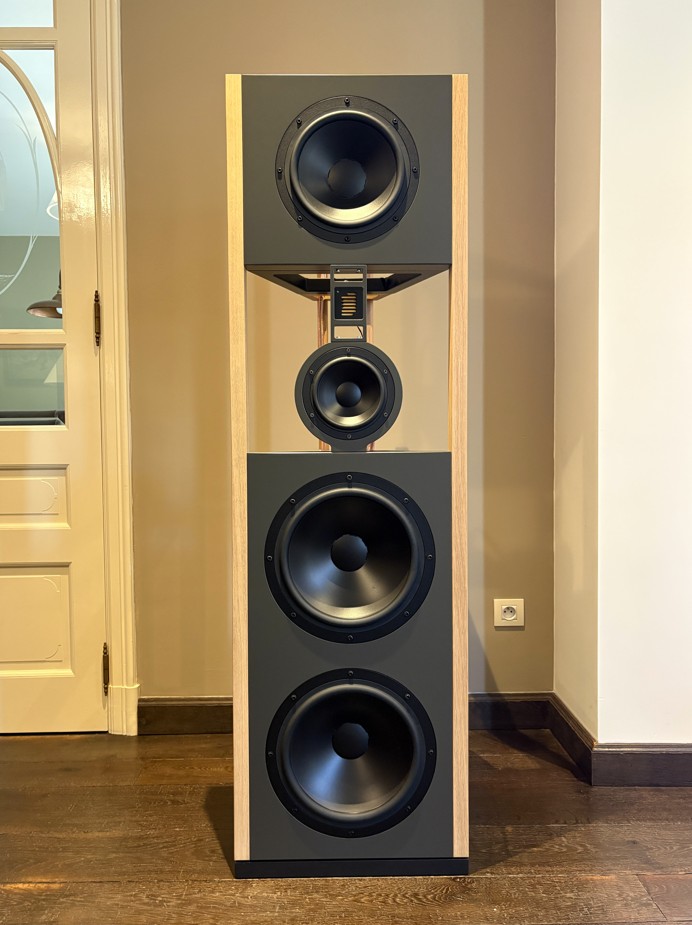
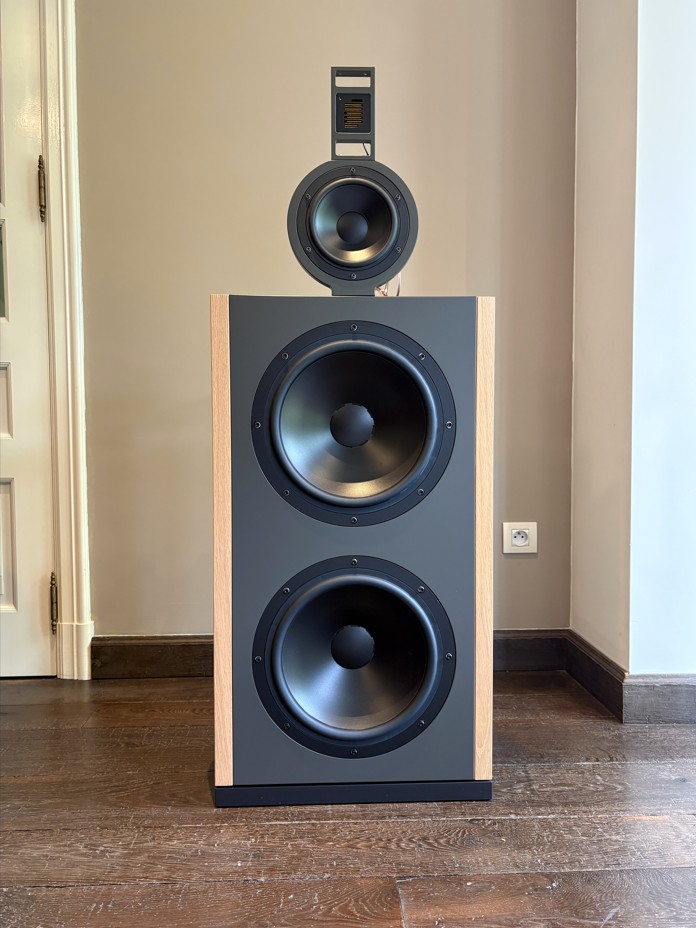
One of the strengths of this cabinet design is that it allows both a 3-way and a 4-way loudspeaker configuration using the same enclosure. This makes direct comparison between the two concepts possible.
In the 4-way system, the addition of a dedicated midwoofer reduces the workload of the midrange driver at lower frequencies. Both 3-way and 4-way loudspeakers share the same overall sonic character, yet each has its own distinctive qualities.
The 4-way version clearly offers greater authority at higher playback levels. It sounds more powerful and delivers increased dynamic impact, making it particularly convincing with demanding musical material.
The 3-way version, on the other hand, presents music in a slightly more relaxed, fluid and transparent manner. It possesses an effortless openness that makes listening highly enjoyable over long periods.
At present, the exact reason for these subtle differences is not yet fully understood. Further listening sessions and carefully controlled experiments with small design changes will be carried out to gain a deeper understanding of the underlying mechanisms.
